Colorectal (bowel) cancer treatment in Istanbul, Turkey
Colorectal (bowel) cancer is usually treated with surgery to remove the tumour — a colectomy for colon cancer, or a total mesorectal excision for rectal cancer, sometimes minimally invasive or robotic — combined with chemotherapy given before or after surgery, and radiation or chemoradiation used especially in rectal cancer to shrink tumours first. Testing the tumour for RAS/BRAF and MSI/MMR status decides whether targeted antibodies or immunotherapy are added. Istanbul hospitals offer this full pathway, often at JCI-accredited, state-authorized centers and well below Western-European prices for the same protocol. Every price we show is an illustrative placeholder until verified partner-hospital quotes exist — and you pay the hospital directly, never us. Start with a free 72-hour review of your reports before you decide anything.
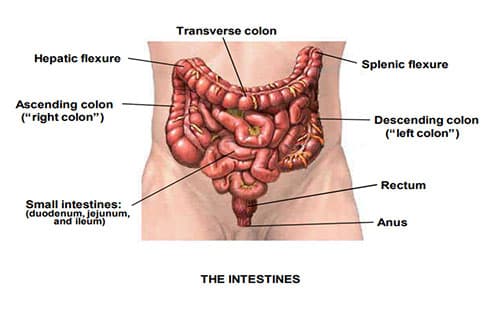
Anatomic drawing of the intestines, showing the segments of the colon and the rectum.
SEER Training Modules, U.S. National Cancer Institute — public domain (opens in a new tab) ↗What colorectal cancer is
The U.S. National Cancer Institute describes colorectal cancer as cancer that forms in the colon or the rectum — the two parts of the large bowel. Colon and rectal cancers are often grouped together because they share features, and most cases are adenocarcinomas, which begin in the gland cells lining the inside of the bowel and can grow outward through the wall. The NCI notes that many colorectal cancers develop from polyps, growths on the inner lining that can be found and removed at colonoscopy before they ever turn cancerous, which is why screening matters.
Diagnosis usually involves a colonoscopy with biopsy, and the extent of disease is worked out with CT imaging, and for rectal tumours a pelvic MRI that helps decide whether radiation is used before surgery. Because colon and rectal cancers behave slightly differently, rectal cancer more often uses radiation as part of the plan. Tumour testing for RAS, BRAF and MSI/MMR status now guides drug therapy. Browse the wider cancer types hub for related diagnoses.
Treatment options
The modalities the NCI lists for colorectal cancer, and an honest note on each:
- Surgery. The mainstay for localized disease — a colectomy to remove the affected part of the colon with nearby lymph nodes, or for rectal cancer a total mesorectal excision, sometimes done minimally invasively or with robotic assistance. A stoma is created in some cases — often temporary — when the bowel cannot be safely rejoined straight away.
- Chemotherapy. Chemotherapy is given before or after surgery to shrink the tumour or treat any remaining disease, and is a mainstay for advanced disease that has spread. Cost scales with the number of cycles.
- Radiation / chemoradiation. Radiation, often combined with chemotherapy, is used especially in rectal cancer to shrink the tumour before surgery. It is used far less for colon cancer. Whether it applies depends on where the tumour sits and its stage.
- Targeted therapy and immunotherapy. Anti-EGFR antibodies such as cetuximab are used for RAS/BRAF wild-type tumours, and anti-angiogenic drugs like bevacizumab more broadly; immunotherapy such as pembrolizumab is used for MSI-high / mismatch-repair-deficient tumours. Which applies is decided by biomarker testing, not a template.
See how these modalities work in general on the treatments & technology hub.
What it costs
There is no single colorectal-cancer price, because the cost is driven by whether the tumour is in the colon or rectum, the type of surgery (open, laparoscopic or robotic, and whether a stoma is created), the number of chemotherapy cycles, whether radiation or chemoradiation is used, and whether targeted or immunotherapy drugsare added — those are priced per cycle and can dominate the total. Every figure OncologyIstanbul™ publishes today is an illustrative placeholder pending verified partner-hospital quotes, and each is itemized so you can hold a real quote up against it line by line. See the Turkey Oncology Price Index or the full cancer treatment cost in Turkey breakdown.
The hospital, verified
We don’t show a wall of smiling surgeons or a “ranked” list — those are the easiest things to fabricate. Instead, you’re matched to one state-authorized Istanbul partner hospital whose colorectal and gastrointestinal oncology subspecialty fits your diagnosis, and you can verify its authorization against the Republic of Turkey Ministry of Health’s own records and its JCI accreditation in JCI’s public directory before you commit. Named specialist profiles appear only when a verified, consented physician is behind the name. See the full guide to cancer hospitals in Istanbul and how to check one yourself.
Where this fits
This is one diagnosis within the broader cancer treatment in Istanbul pillar. If you want your own reports read first, a free second opinion organizes and verifies your pathology, colonoscopy and imaging into a plain-language case file in your language before you decide whether to travel.
Related cancers
You might also look at
Check everything here — us included
Common questions
Can I get colorectal (bowel) cancer treatment in Turkey?
Yes. Istanbul hospitals provide the full colorectal-cancer pathway the U.S. National Cancer Institute describes — surgery to remove the tumour (a colectomy for colon cancer, or a total mesorectal excision for rectal cancer, sometimes minimally invasive or robotic), chemotherapy given before or after surgery, radiation or chemoradiation used especially in rectal cancer, and targeted or immunotherapy drugs where the tumour testing supports them. Many centers hold JCI accreditation and Turkish Ministry of Health state authorization, both of which you can check yourself before you commit. The honest first step is a free case review of your pathology, colonoscopy and imaging so the plan is understood before you travel.
Will I need a stoma or colostomy?
Often not, and when one is needed it is frequently temporary. Per the NCI, a stoma is created when the surgeon cannot safely rejoin the bowel straight away — this is more common in low rectal tumours than in colon cancer. Many colon operations reconnect the bowel in the same procedure with no stoma at all, and many rectal cases use a temporary stoma that is reversed weeks or months later once the join has healed. Whether one applies, and whether it would be temporary or permanent, depends on where the tumour sits and is a decision for a surgical-oncology team. A case review will tell you what your reports do and don't yet establish about this.
Why do RAS/BRAF and MSI tests matter for colorectal cancer?
Because they decide which drugs can work. Per the NCI, anti-EGFR antibodies such as cetuximab or panitumumab are used only for tumours that are RAS and BRAF wild-type — if a RAS or BRAF mutation is present those drugs are not expected to help, so the testing prevents a wasted, toxic treatment. Tumours are also tested for MSI-high or mismatch-repair-deficient status, which can point to immunotherapy such as pembrolizumab. Anti-angiogenic drugs like bevacizumab are used more broadly. This biomarker testing is a standard part of the modern workup, and a case review will flag whether it has already been done on your reports. This is general information, not a treatment recommendation.
How much does colorectal cancer treatment cost in Istanbul?
There is no single figure, because the cost is driven by whether the tumour is in the colon or rectum, the type of surgery (open, laparoscopic or robotic, and whether a stoma is created), the number of chemotherapy cycles before or after surgery, whether radiation or chemoradiation is used, and whether biomarker-guided targeted or immunotherapy drugs are added — those drugs are priced per cycle and can dominate the total. Istanbul typically runs well below Western-European prices for the same protocol, but every figure OncologyIstanbul™ publishes today is an illustrative placeholder pending verified partner-hospital quotes, itemized so you can check a real written quote line by line. See the Turkey Oncology Price Index for current ranges.
Start with a free 72-hour case review
Send your pathology and imaging. Get a verified case file in your language — free, confidential, no obligation.
This page is general information, not medical advice. Medical facts are grounded in the U.S. National Cancer Institute; prices shown are illustrative placeholders pending verified partner-hospital quotes, not offers. Every cancer case is individual; assessments are based on the reports you provide and do not replace in-person examination.