Kidney cancer treatment in Istanbul, Turkey
Kidney (renal cell) cancer is treated in Istanbul with the same core options the U.S. National Cancer Institute describes — surgery to remove the tumor or the kidney, and targeted therapy or immunotherapy when the disease is advanced — usually well below Western-European prices. OncologyIstanbul™ isn’t a hospital: we give you a free 72-hour review of your own reports and hand you the tools to verify any hospital yourself before you decide anything.
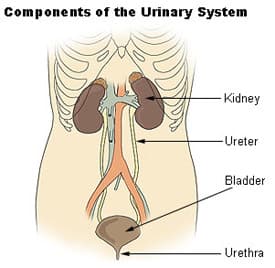
The urinary system — the kidneys filter blood to form urine, which drains through the ureters into the bladder and leaves via the urethra.
SEER Training Modules, U.S. National Cancer Institute — public domain (opens in a new tab) ↗What kidney cancer is
Kidney cancer forms in the tissues of the kidney. The U.S. National Cancer Institute groups it into renal cell cancer (renal cell carcinoma, by far the most common form in adults), transitional (urothelial) cell cancer of the renal pelvis, and Wilms tumor, which occurs mainly in children. Many kidney tumors are found incidentally on imaging done for another reason. Diagnosis and staging typically rely on ultrasound, CT or MRI, and blood and urine tests — unlike many cancers, a needle biopsy is not always done before surgery, because the tumor is often removed and examined directly. For the primary-source description, see the NCI’s kidney cancer overview (opens in a new tab).
Treatment options
These are the modalities the NCI lists for renal cell cancer. Which apply to you depends on stage and tumor type, and is a decision for the treating team — not something to promise in advance.
- Partial nephrectomy (nephron-sparing surgery). Removes the tumor and a margin while preserving the rest of the kidney — often the goal for smaller, localized tumors, and frequently done laparoscopically or robot-assisted.
- Radical nephrectomy. Removes the whole kidney, sometimes with the adrenal gland and nearby lymph nodes, when the tumor is larger or the partial approach isn’t feasible.
- Active surveillance or ablation. For some small kidney masses or patients who aren’t surgical candidates, the NCI notes watchful monitoring or ablation (cryotherapy, radiofrequency) as options.
- Targeted therapy. Anti-angiogenic and other targeted drugs (for example the VEGF and mTOR pathway agents) are used mainly for advanced or metastatic renal cell cancer.
- Immunotherapy. Immune checkpoint inhibitors — and, historically, high-dose interleukin-2 — are used for advanced disease, sometimes combined with targeted therapy.
- Radiation therapy. Plays a limited role in kidney cancer, used mainly to relieve symptoms or treat spread rather than as a primary cure.
Full detail is in the NCI’s Renal Cell Cancer Treatment (PDQ) (opens in a new tab). See also the treatments & technology hub.
What it costs
There is no single price for kidney cancer, and we won’t invent one. The cost is driven by the specifics of yourplan: whether it’s a partial or radical nephrectomy, open versus laparoscopic or robot-assisted surgery, the stage, how much imaging and pathology is needed, length of hospital stay, and — for advanced disease — whether months of targeted therapy or immunotherapy drugs are involved, which can dominate the total. Every price we publish today is an illustrative placeholder pending verified partner-hospital quotes, and each figure is itemized so you can hold a real quote up against it, line by line. See the Turkey Oncology Price Index or the full cancer treatment cost in Turkey breakdown. You pay the hospital directly, only after you approve an itemized written quote — never us.
The hospital, verified
We don’t show you a “top” kidney-surgery ranking or a wall of smiling doctors — those are the easiest things to fabricate. Instead, you’re matched to one state-authorized Istanbul partner hospital whose urologic-oncology subspecialty fits your diagnosis, and you can verify its authorization against the Republic of Turkey Ministry of Health’s own records and its JCI accreditation in JCI’s public directory before you commit. Named specialist profiles appear only when a verified, consented physician is behind the name. See the full guide to cancer hospitals in Istanbul and how to check one yourself.
Related cancers
You might also look at
Check everything here — us included
Common questions
Can I get kidney cancer treatment in Turkey?
Yes. Istanbul hospitals routinely treat renal cell carcinoma with the same modalities the U.S. National Cancer Institute describes — nephron-sparing (partial) or radical nephrectomy, often laparoscopic or robot-assisted, plus targeted therapy and immunotherapy for advanced disease. OncologyIstanbul™ is not a hospital: we organize and verify your reports into a case file, then — if you want to travel — match you to a state-authorized partner hospital by urologic-oncology fit. The clinical decision is always made by the treating team, not by us.
How much does kidney cancer treatment cost in Istanbul?
It depends heavily on the plan: a partial or radical nephrectomy for a localized tumor is a different cost from advanced disease that needs months of targeted therapy or immunotherapy drugs, imaging and follow-up. Istanbul is typically well below Western-European prices for the same surgery, but every figure OncologyIstanbul™ publishes today is an illustrative placeholder pending verified partner-hospital quotes, itemized so you can check any real quote against it line by line. See the Turkey Oncology Price Index and the cancer-treatment-cost breakdown for current ranges.
Is robotic or laparoscopic nephrectomy available in Istanbul?
Minimally invasive (laparoscopic and robot-assisted) partial and radical nephrectomy are performed at major Istanbul oncology centers, and for some small kidney tumors ablation or active surveillance may be options the NCI also lists. Which approach fits your tumor is a decision for the operating urologist based on tumor size, stage and location — we do not promise a specific technique in advance, and any hospital that guarantees one before reviewing your imaging is a red flag.
What is the success rate for kidney cancer treatment?
There is no single honest number. Outcomes for kidney cancer depend on the tumor type, stage at diagnosis, whether it has spread, and your overall health — they are individual, not a marketing statistic. Any provider quoting you a blanket 'success rate' as a selling point is overpromising. We give you an organized case file and published price references so you and your own doctor can weigh a real plan; we never predict your result.
This page is part of the wider guide to cancer treatment in Istanbul, Turkey. When you’re ready, the free second opinion organizes your reports into a verified case file in your language.
Start with a free 72-hour case review
Send your kidney pathology and imaging. Get a verified case file in your language — free, confidential, no obligation.
This page is general information, not medical advice. Every cancer case is individual; assessments are based on the reports you provide and do not replace in-person examination or the judgment of your treating team.